
When the president of Colorado WINS learned that the president of the United States might be targeting Denver next in his anti-immigration campaign of terror, she knew how she’d begin to mobilize. One simple thing Diane Byrne does is deck out her activists in matching T-shirts. Wearing union colors promotes team spirit and builds confidence, she says, showing that “we’re all here doing this together.”

Likewise, when you’re planning a mobilization, Byrne advises building in some down time. People like to get acquainted and know who’s with them in the fight.
The AFT Public Employees program and policy council, meeting in New York City Feb. 5-6, abounded with tips to help locals mobilize. To increase members’ power, make sure they know exactly what they’re fighting for. Then choose your tactics. No tactics are right or wrong, the leaders agreed. What they should be is memorable.
PPC chair Gary Feist, president of North Dakota Public Employees, recommended finding members who can tell a moving personal story, which will draw media attention. With more media on the issue, he said, legislators will become more motivated to fix the problem.
Building people power
Virtually every union leader finds it challenging to mobilize people, an AFT state legislative expert reassured the group. Even where members do mobilize and share the load among themselves, “It’s not that activists are less busy. Sometimes they’re the most busy. But they make it work.”
When planning a campaign, some affiliates use SMART goals. That stands for specific, measurable, achievable, relevant and time-bound. These goals don’t have to be about winning a particular bill or funding level, but about improving outcomes for members and the wider community.
Things to consider: Your local’s number of members, its budget and technology. Are your members trained to go to the capital and rally? Are they well-versed in the proposed legislation? Are they acquainted with key decision-makers, including the governor and committee chairs? Does your local have primary and secondary goals in mind? And do you have the people power to reach your goals?
Reviewing best practices, the public employee leaders started with basic logistics for lobbying at the state capitol. Say you are planning a lobby day. To keep things orderly, register participants in advance and make a checklist. You’ll need buses and drivers. You’ll need parking. And lunches for members. You may want access to the capitol rotunda, a sound system and bullhorns in case the sound system fails. You’ll need to factor in the acoustics in the rotunda. And you’ll have to know the layout of the capitol building.
You’ll need to know how to connect lawmakers with citizens, and if the lawmakers try to blow you off, how to catch them in the halls. You’ll have to provide members with contacts in case questions arise, and they will need training in how a bill is passed. Give them talking points on palm cards or leaflets.
Plan for “visuals,” too. During a lobby day, members can march around their state capitol building, so people can see them from the windows and across the street. Good signs have great impact.
Enlist other unions as well, said Benjamin Kuiper of the Montana Federation of Public Employees: “We managed to kill a lot of bad bills last year.”
The value of lobby days
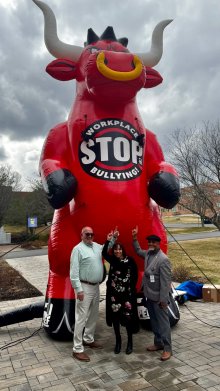
Lobby-day attendance ticks up and down, and unfortunately, it’s been down since the COVID-19 pandemic, said Randi DiAntonio, vice president of the New York State Public Employees Federation. The hardest part is getting people there—they have to take a day off work or give up a weekend day. Make it easy for them, DiAntonio advised. Let them bring their kids, and if you have enough members living near the capital who will turn out, just call on them instead of trying to draw people from all over the state.
“If they do it, 95 percent will come back the next year,” DiAntonio said. “Feed them, train them and make sure they’re partnered with members who know what they’re doing. That matters.”
You know Scabby the Rat, right? Well, last year PEF brought in a 20-foot inflatable bull named STOMP, for Stop Treating Our Members Poorly. That bull “put the fear of God” in PEF’s adversaries and energized its members, DiAntonio said. The threat of bringing STOMP to an agency usually gets their attention.
The PPC also discussed including nontraditional activities at protests, like the large crowds singing in Minnesota. Assemble a rapid response team through a listserv, so you’ll have union messengers ready to share your posts on social media or send messages to lawmakers over lunch.
Encouragement from AFT officers
When AFT Secretary-Treasurer Fedrick Ingram first came to our national union, he told the PPC, he was amazed by the number of job titles, from parole officer to chemist. Without the work that public employees do, nothing gets done, he said. Ingram thanked Jill Cohenour of Montana, who is retiring from the PPC, for her years chairing the group. Cohenour replied by saying she’d be joining AFT Retirees, of course.
AFT Executive Vice President Evelyn DeJesus gave a fiery speech about “when you’re called to be a leader.”
The council also chatted with AFT President Randi Weingarten about dealing with the Trump administration’s assaults on the public sector. “These guys are on the road to fascism,” she lamented. “Division and hate are their main vehicles to maintain power. They’re going to get worse, not better.”
Tell them a story
Coordinate where, when and how members show up. You don’t want legislators wrestling with a math problem when discussing the budget; you want them to remember the nurse who came and talked with them about her concerns for patient safety. No member needs to be an expert; they just need to tell how their life is impacted. For instance, if Walmart paid its workers better, they wouldn’t need to rely so much on public services. It’s a set of choices. Bringing five people to the capitol once a week, even if they’re the same people, will eventually lead lawmakers to enlist the union in solving a problem.
If your programs are federally funded, the AFT might bring you to speak with members of Congress and their staff in Washington, D.C. This has happened a number of times when PPC member Sue Parton, president of the Federation of Indian Service Employees, has provided expert testimony on Native American public services and other tribal matters.
Ryan Clark, president of the New York State Lifeguard Corps, heartily endorsed deploying both union colors and loud rallies. One thing he and his members really want is language in their contract that would reduce the vesting period in Tier 6 of the state pension plan.
“We have to get the legislators who are sitting on the fence,” he said, “and ignore the ones who will never be with us.”
Matt Emigholz, president of the Illinois Federation of Public Employees, said his affiliate holds Full Funding Fridays, especially when there’s a hard deadline coming up on a funding bill. And he confirmed that onlookers will say: “Oh, I saw those blue shirts.”
Members who work in healthcare should wear their scrubs and lab coats, suggested Bill Garrity, president of the University Health Professionals in Connecticut. The best situation, he said, is when even the people you’re fighting know in their heart of hearts that you’re fighting for them, too.
[Annette Licitra]